Why do wardrobes and shoe racks smell musty, and how do you stop it?
Humid nights, closed doors and sweaty trainers turn cupboards musty. Here is what the smell is, why UAE homes get it and how to fix it for good.
Short answer: A musty smell in a wardrobe or shoe rack usually means damp. Mould and mildew growing in humid, still air give off gases with that stale, earthy smell, and sweaty shoes add bacterial odour. Dry everything fully, let air move, keep the room below 60% humidity and clean the surfaces. Then deal with whatever smell is left.
What is the musty smell in my wardrobe?
That smell is usually mould or mildew. Moulds release gases called microbial volatile organic compounds (mVOCs), and the US EPA says these are often behind the musty odour people associate with mould. The EPA also says a mouldy smell suggests mould is growing somewhere in the building and should be investigated, even if you cannot see it. Mildew is simply the everyday name for mould growing on fabric, leather and other surfaces.
Mould needs moisture. According to the EPA, if damp materials are dried within 24 to 48 hours, mould will not grow in most cases. A wardrobe full of clothes that never quite dried, behind doors that stay shut, gives it all the time it needs.
Shoes are slightly different. The NHS explains that smelly feet come mainly from a build-up of sweat and bacteria, and that smell moves into the shoe. Put damp trainers into a closed cabinet and you combine both problems: bacterial odour and damp that never dries.
Why do wardrobes smell musty in UAE homes?
You might expect a desert climate to keep cupboards fresh. In practice, many UAE homes combine several things that encourage that musty smell:
- Humid coastal air. Summer nights on the coast can be very humid, and that moisture gets into rooms every time doors and windows open.
- AC switched off while you travel. Weeks of summer travel with the AC off leave a closed, warm, humid home, and wardrobes are the last place air reaches.
- Built-in wardrobes on outside or bathroom walls. Air barely moves behind the panels, and a leak, a dripping AC drain line or damp in the wall can go unnoticed for months.
- Clothes put away slightly damp. Towels, thick fabrics, kanduras and abayas dried on a humid day, or gym kit folded straight from the bag.
- Packed rails and closed doors. Big families mean full wardrobes, and full wardrobes have no airflow.
- Sweaty shoes in closed cabinets. Trainers, school shoes and sandals go straight into the cabinet by the front door, and at Eid the rack overflows with guests' shoes too.
Cause, sign and fix: what is making your cupboard smell?
| Cause | Sign | Fix |
|---|---|---|
| Clothes stored damp | Smell strongest on towels, gym kit and thick fabrics | Dry fully in a dryer or an air-conditioned room before storing |
| Humid room (AC off, travel, humid nights) | Whole wardrobe smells, clothes feel slightly damp, spots on leather bags or shoes | Run the AC or a dehumidifier and keep humidity below 60% |
| No airflow | Smell hits you when you open the door, fades after airing | Gaps between hangers, open the doors daily, do not overfill |
| Damp in the wall (leak, AC drain, outside wall) | Dark patches, peeling paint, swollen panels, smell returns soon after cleaning | Fix the water source first; call maintenance |
| Sweaty shoes | Sour smell in the shoe cabinet, damp insoles | Rotate pairs, dry shoes before storing, wash insoles |
| Mould on surfaces | Visible spots, often in corners or on the back panel | Scrub with detergent and water, then dry completely |
How do I get rid of a musty smell in my wardrobe?
- Empty it and look. Check the back panel, corners, floor and top for spots, stains, swelling or peeling paint. If you find a leak or a damp patch in the wall, get it fixed first: nothing else lasts until the source is dry.
- Wash or air whatever smells. Launder what you can and make sure every item is completely dry before it goes back. Air leather bags and shoes in a cool, dry room.
- Clean the inside. The EPA's advice for mould on hard surfaces is to scrub it off with detergent and water and dry completely. Wipe the shelves, rails and walls, then leave the doors open with the room's AC on until everything is dry.
- Put things back with space. Leave gaps between hangers, take clothes out of plastic dry-cleaning covers and keep the wardrobe floor clear so air can move.
- Open the doors regularly. A few minutes a day, or a few hours once a week, lets damp air escape.
- Add moisture absorbers. Moisture-absorbing tubs in the corners collect water from the air. Check them often and replace them when full.
- Control the room's humidity. The US EPA advises keeping indoor humidity below 60%, ideally between 30% and 50%, and using air conditioners or dehumidifiers when needed. A small hygrometer shows where you stand. If the room stays humid with the AC running, a dehumidifier is the next step: Stadler Form explains how to choose one for walk-in wardrobes and rooms without windows.
- Plan for travel. Before a long trip, empty the laundry basket and leave wardrobe doors slightly open. Consider leaving the AC running at a higher temperature setting, or a dehumidifier on a timer, so the house does not sit warm and humid for weeks. Our guide to coming home to a fresh fridge after summer travel covers the kitchen.
How do I get rid of shoe smell?
- Rotate your pairs. The NHS suggests not wearing the same shoes two days running and letting shoes dry out before you wear them again.
- Dry them before they go away. After the gym, padel or a long day, leave shoes somewhere airy with the insoles pulled out, not straight in a closed cabinet.
- Wash the insoles. Removable insoles hold much of the sweat. Wash them as the label allows and dry them fully, or replace worn ones.
- Use baking soda overnight. Sprinkle a spoonful into each dry shoe, leave it overnight and tip it out in the morning.
- Wash what can be washed. Many canvas trainers can go in the machine; check the care label first.
- Choose breathable socks. The NHS recommends breathable or natural fabrics such as cotton.
- Give the cabinet air. A ventilated or open rack is easier to keep fresh than a closed cabinet. If yours has solid doors, open them daily and wipe the shelves every month.
Do shoe rack smell absorbers work?
It depends on the type. Moisture absorbers deal with damp, not odour. Baking soda and charcoal bags absorb odour molecules until they are full, then need replacing. Scented sachets, sprays and scented shoe deodorisers only mask the smell, and once the scent fades the original odour is still there. Whatever you choose works far better in a dry, clean cabinet than in a damp one.
Where Deo helps, and where it does not
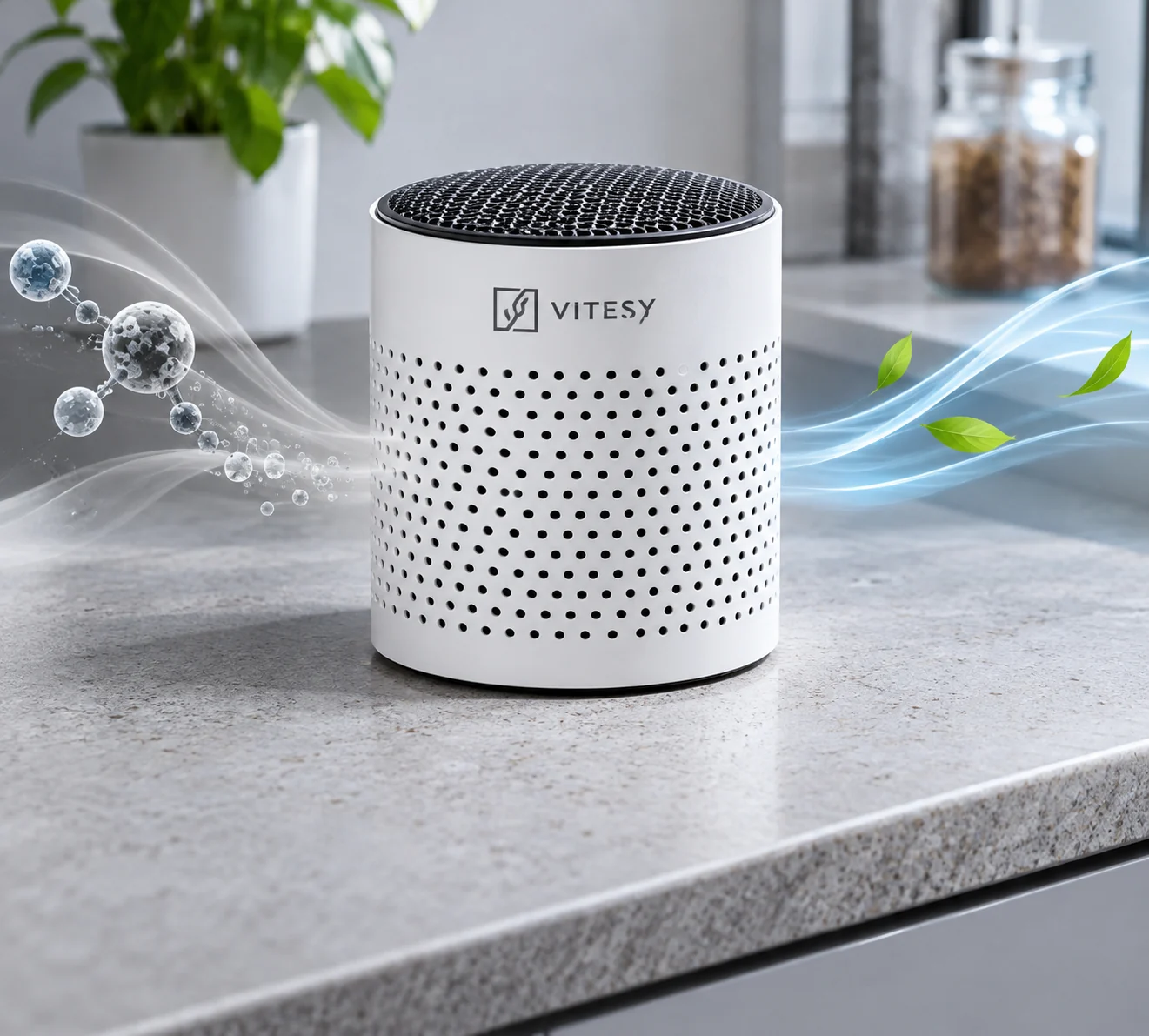
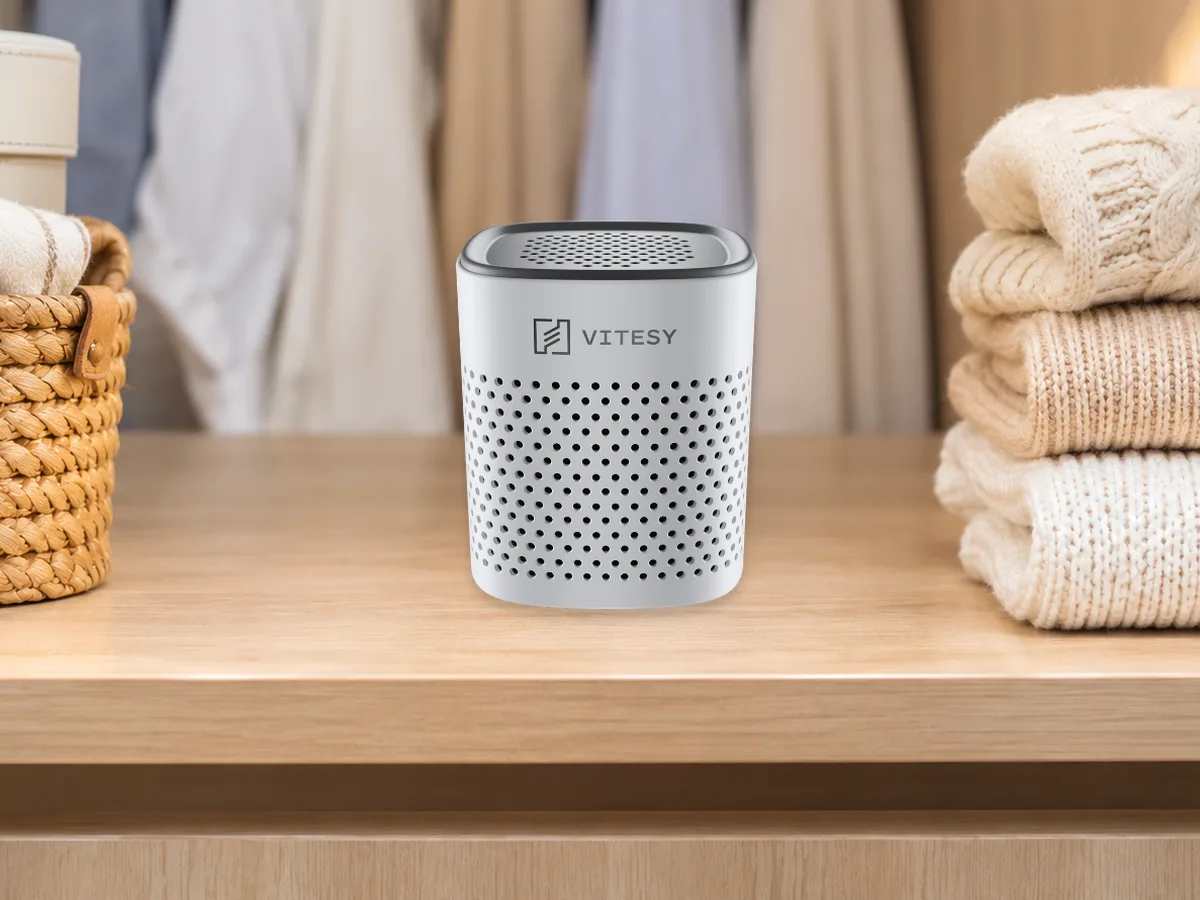
Deo is VITESY's fragrance-free odour eliminator for small closed spaces. A ceramic catalytic filter breaks odour molecules down into carbon dioxide and water at room temperature, with no power, no batteries and no refills. In Vitesy's lab tests in a sealed 60-litre box, a fish-type and a sulphur-type odour compound fell below the detection limit within 2 hours. Those tests used specific compounds, not mould, and Vitesy's own guidance is that Deo may significantly reduce odours without necessarily eliminating them completely. Vitesy says most homes notice a difference within 72 hours.
Humidity matters here too. Deo works best between 40% and 80% relative humidity, and high humidity or condensation can temporarily reduce its efficiency, so fix the damp first. A room kept at around 40 to 60% suits both your clothes and Deo. Use one per small shoe cabinet and more for a large wardrobe, leave about 5 cm of space around each unit, and clean it with a damp cloth, never under the tap. The same thinking applies in the car: see our guide to getting rid of car smells in a Dubai summer.
In the UAE, VITESY is distributed by PRO TECHnology, a Dubai company.
Frequently asked questions
How do I get rid of the humidity smell in my closet?
Empty the closet, wash or air anything that smells and make sure it is completely dry. Clean the inside with detergent and water, then let it dry with the doors open. Put clothes back with space between hangers, add moisture absorbers and keep the room below 60% humidity with the AC or a dehumidifier. If the smell returns quickly, check for a leak behind the wall.
Why is there a musty smell in my wardrobe?
A musty smell usually means mould or mildew growing in damp, still air. Moulds release gases called mVOCs that cause that stale, earthy smell. In UAE homes the usual triggers are clothes put away slightly damp, humid air while the AC is off, packed rails with no airflow, and built-in wardrobes on outside or bathroom walls where leaks go unnoticed.
Does humidity cause bad smell?
Indirectly, yes. Humid air keeps fabric, wood and leather damp, which lets mould and bacteria grow, and they produce the smell. The US EPA advises keeping indoor humidity below 60%, ideally between 30% and 50%. Lowering humidity with the AC or a dehumidifier, and drying things fully before you store them, stops most musty smells from coming back.
How do I get rid of shoe smell?
Rotate pairs so each one dries out between wears, as the NHS suggests. Pull out and wash the insoles, sprinkle baking soda into dry shoes overnight and tip it out in the morning, and wear breathable socks. Store shoes on a ventilated rack or open the cabinet doors daily, and never put damp sports shoes straight into a closed cabinet.
What is a good shoe cabinet smell remover?
Start by drying and cleaning: wipe the shelves, air the cabinet and keep damp shoes out. Then pick something that deals with odour rather than masking it. Baking soda and charcoal absorb odours until they are full. A catalytic device such as VITESY Deo breaks odour molecules down, needs no power or refills and adds no fragrance. One unit suits a small cabinet.
Does Deo work in a humid wardrobe?
Deo works best between 40% and 80% relative humidity. Very high humidity or condensation can temporarily reduce its efficiency, so dry the wardrobe and lower the room's humidity first. Vitesy's own guidance is that Deo may significantly reduce odours without necessarily eliminating them completely, so use it to keep a dry, clean wardrobe neutral, with one unit per small space and more for large wardrobes.